
Economic growth often focuses on degrees and diplomas while ignoring massive population that has not cleared Class 10th. While passing Class 10th opens doors to formal training and apprenticeships, those without it face permanent financial exclusion. Without specific pathways, individuals who drop out early are pushed entirely into low-wage informal sector. Tailored skill programs act as vital intervention, turning unskilled manual laborers into skilled trade workers without requiring formal school certificate.
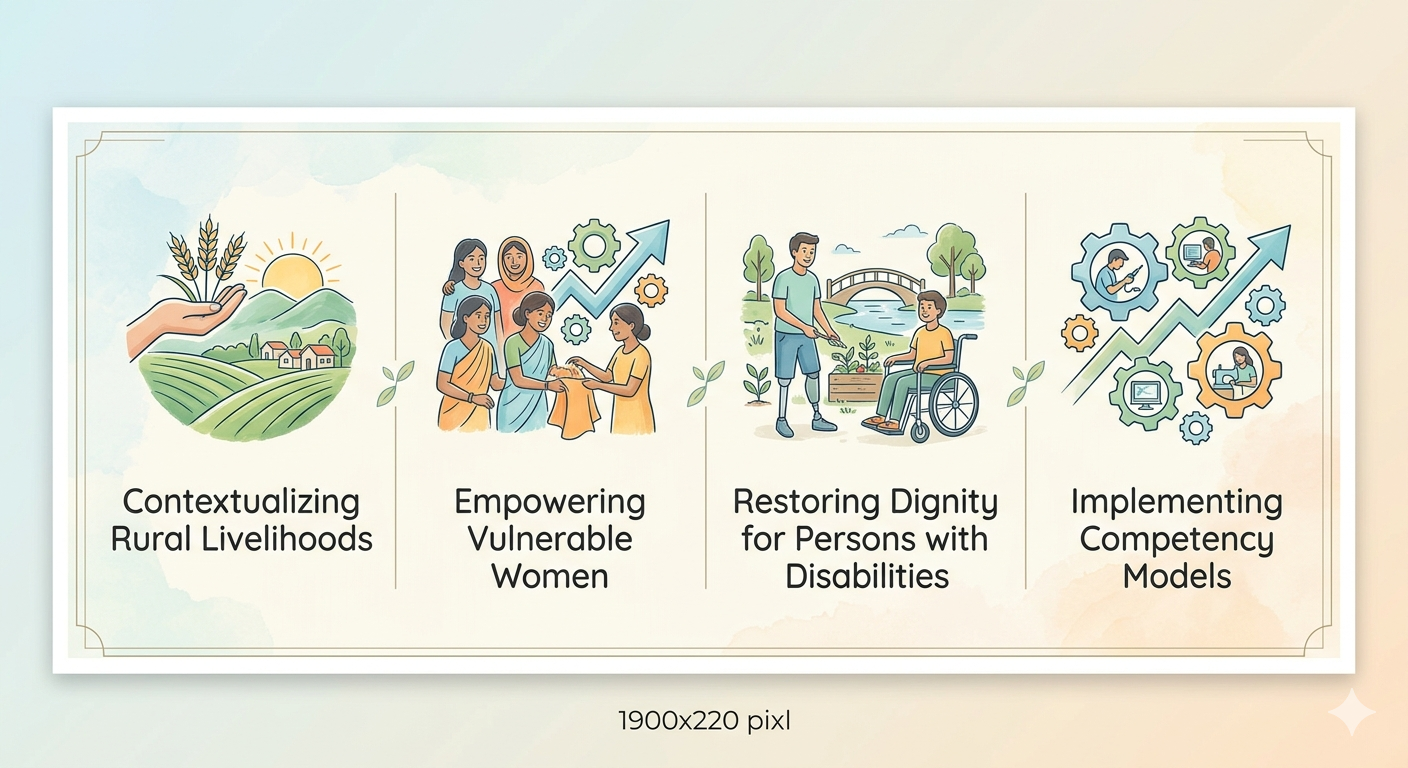
Contextualizing Rural Livelihoods
In rural areas, dropping out of school often means underemployment or desperate migration to overcrowded cities. EssEnnTials Social Lab designs intervention strategies specifically for these population segments by mapping out precise localized needs. Organization builds capability frameworks centered around immediate village economies rather than urban corporate roles. Training modules focus on practical, non-textbook areas like sustainable farm management, solar component repair, and community waste recycling systems. This specific alignment allows rural youth to find gainful occupation within their own geographies, creating micro-entrepreneurs and reducing pressure of unsafe urban migration.
Empowering Vulnerable Women
For girls in vulnerable communities, dropping out before Class 10th often leads directly to early marriage or unpaid domestic labor. EssEnnTials Social Lab counters this by creating micro-enterprise models tailored around domestic constraints faced by non-schooled women. Training takes place in flexible community hubs, focusing on scalable skills like decentralized food processing, apparel manufacturing, regional textile arts, and neighborhood day-care management. This setup allows women to balance earning potential with family structures. Gaining independent income gives them vital shot at financial independence, provides social leverage, and ensures better resources for household advancement, effectively breaking dropout cycle for next generation.
Restoring Dignity for Persons with Disabilities
Persons with disabilities face massive systemic barriers in completing formal education due to lack of accessible infrastructure, and conditioning skill training on school certificate double-penalizes them. Programs at EssEnnTials Social Lab counter standard educational exclusion by creating physical and digital tasks adapted for diverse physical capacities. Training shifts completely away from heavy reading and emphasizes visual memory, tactile skills, and specialized packaging techniques. Individuals learn to navigate specific workplace tools, shifting from dependency or historical charitable reliance to active economic contribution and self-reliance.
Implementing Competency Models
To fully include this left-behind population, standard skill programs must abandon textbook-heavy curriculums, language proficiency barriers, and strict entry prerequisites. EssEnnTials Social Lab implements this structural operational shift by discarding traditional exam structures in favor of practical verification. Trainees demonstrate skill mastery through real-time construction, repair, or creation tasks rather than written tests. Recognition of prior experience plays central role in honoring informal knowledge base already present among candidates. Lowering academic barriers and focusing entirely on practical, vernacular competency transforms vulnerable population into resilient, productive workforce.

